
Restoring Nepal’s Soils: A Project Grounded in a Well-Documented Emergency
We are preparing a Biochar in Nepal project for soil restoration, aimed at improving water retention and crop yields. It is important to understand that Nepal faces numerous challenges due to its terrain, climate, and the effects of climate change. This project does not respond to an isolated intuition: it is grounded in a context of soil degradation that is extensively documented by scientific research and international institutions.
A country where soil degradation directly threatens livelihoods
Nepal is a country where more than 90% of the population depends directly on land resources for food, fuel, and shelter. Yet this foundation is under strain: according to Nepal’s Ministry of Environment, Science and Technology, more than 28% of the national territory is now in a degraded state (Government of Nepal, MoEST, 2008). Another reference study puts the figure at 3.16 million hectares, 11.81% of the country’s total area, affected by degradation processes, impacting roughly 38% of forests, 37% of pastures, and 10% of agricultural land (Chalise, Kumar & Kristiansen, Soil Systems, 2019).
These figures translate into substantial soil loss. The average national erosion rate is estimated at 25 tonnes per hectare per year, amounting to a total annual loss of roughly 369 million tonnes of soil (Koirala, Thakuri, Joshi & Chauhan, Geosciences, 2019).
A recent 2025 study focused specifically on eastern Nepal, based on RUSLE modelling and remote sensing, confirms this trend: nearly 3% of the studied area already falls into the “severe to extreme” erosion category (over 80 tonnes/ha/year), and the Himalayan zones lose up to 26 tonnes of soil per hectare each year, significantly more than the hill or Terai regions (Adhikari & Parajuli, Journal of Sedimentary Environments, 2025). Another field study conducted in 2023 in the Himalayan watersheds of Aadhikhola and Tinahukhola measured similar losses, between 24 and 41 tonnes/ha/year, confirming that it is precisely the most heavily cultivated sloped farmland that erodes fastest (Joshi et al., Heliyon, 2023).
This erosion is not an abstract phenomenon: every year it strips Nepali farmers of part of the fertile topsoil their harvests depend on, in a country where rugged terrain, from the plains of the Terai to the Himalayan peaks, leaves little room for error.
A terrain and climate that structurally worsen the problem
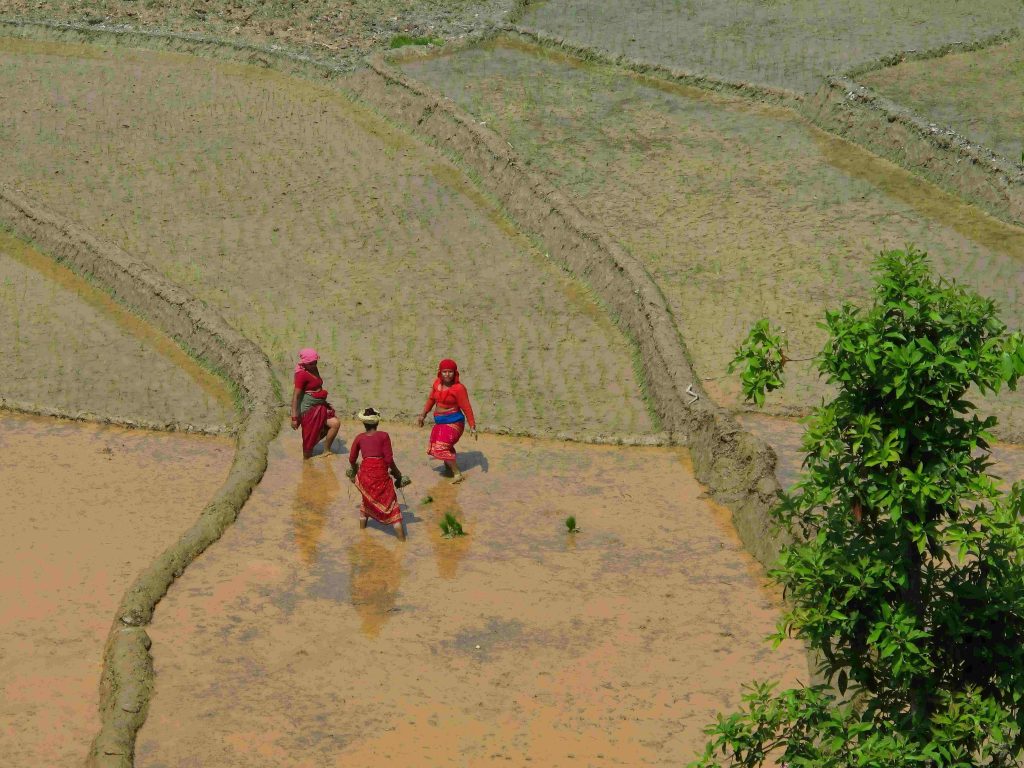
Nepal’s geography largely explains this vulnerability. The country combines steep slopes, an intense and concentrated monsoon season, and farming practiced on terraces that are often ancient but fragile. These conditions promote rapid water runoff, which does not have time to infiltrate the soil before carrying fertile particles down into the valleys.
Climate change is amplifying this dynamic. Nepal ranks among the most vulnerable countries in the world according to the University of Notre Dame’s ND-GAIN Index, placing 122nd out of 183 countries in 2026 (ND-GAIN Country Index). According to projections by the Asian Development Bank, Nepal could lose up to 2.2% of its annual GDP by 2050 due to climate change (Asian Development Bank, Climate Risk Country Profile: Nepal), a particularly concerning figure given that agriculture still accounts for close to 22% of national GDP and employs more than 61% of the workforce (The Global Economy, World Bank data). The Climate Risk Index, which measures the real-world impact of climate-related disasters, ranked Nepal among the ten most affected countries in the world just a few years ago; while it now ranks 69th in the 2025 edition, this relative improvement masks a persistent vulnerability to floods, landslides, and droughts (Germanwatch, Climate Risk Index 2025, as reported by Online Khabar).
Water retention: a decisive link in the chain
Improving water retention in the soil is therefore not a secondary objective: it is a direct response to the leading identified cause of land degradation in Nepal. A recent remote-sensing study (using MODIS NDVI data combined with Google Earth Engine) estimates that around 60% of Nepal’s agricultural land receives irrigation for at least part of the year, but a much smaller share benefits from year-round irrigation, leaving crops dependent on the vagaries of the monsoon (ScienceDirect, 2024). The Nepali government, through its 2015-2035 Agriculture Development Strategy, has in fact set a target of reaching 60% irrigation coverage by 2025 and 80% by 2030, a goal that underlines just how much water management is already recognized as a national priority (Kathmandu Post, 2023).
Improving the soil’s capacity to retain water both reduces the runoff responsible for erosion and secures agricultural yields against increasingly erratic rainfall.
Biochar in Nepal: a solution building on existing practices
This project does not start from a blank slate. A study specifically dedicated to biochar use in Nepal’s mountain farmland shows that this solution is already known locally: mountain farmers traditionally produce biochar from underutilized residual biomass, through a local system known as “bukma,” notably for crops such as millet and potatoes. The documented results are consistent with the international scientific literature on the subject: biochar reduces soil bulk density, improves nutrient retention, and increases water-holding capacity, a triple benefit that directly addresses the three areas raised in the introduction: soil restoration, water retention, and improved crops.
The project’s challenge is therefore less about importing an external technology than about structuring, professionalizing, and scaling up a farming practice already rooted locally, using modern production methods (such as small-scale gasifiers) to multiply its impact.
Conclusion
The difficulties Nepal faces, rugged terrain, extreme monsoon patterns, growing exposure to climate change, are not simple, temporary obstacles: they are documented, measured, and set to worsen if nothing is done. In this context, a Biochar in Nepal project built around soil restoration and improved water retention is not a gamble, but a response consistent with the very recommendations of the local scientific literature, which explicitly calls for sustainable land management practices, reforestation, and conservation techniques adapted to sloped terrain.
If you’d like more information about this project, or want to discuss another one, feel free to get in touch.